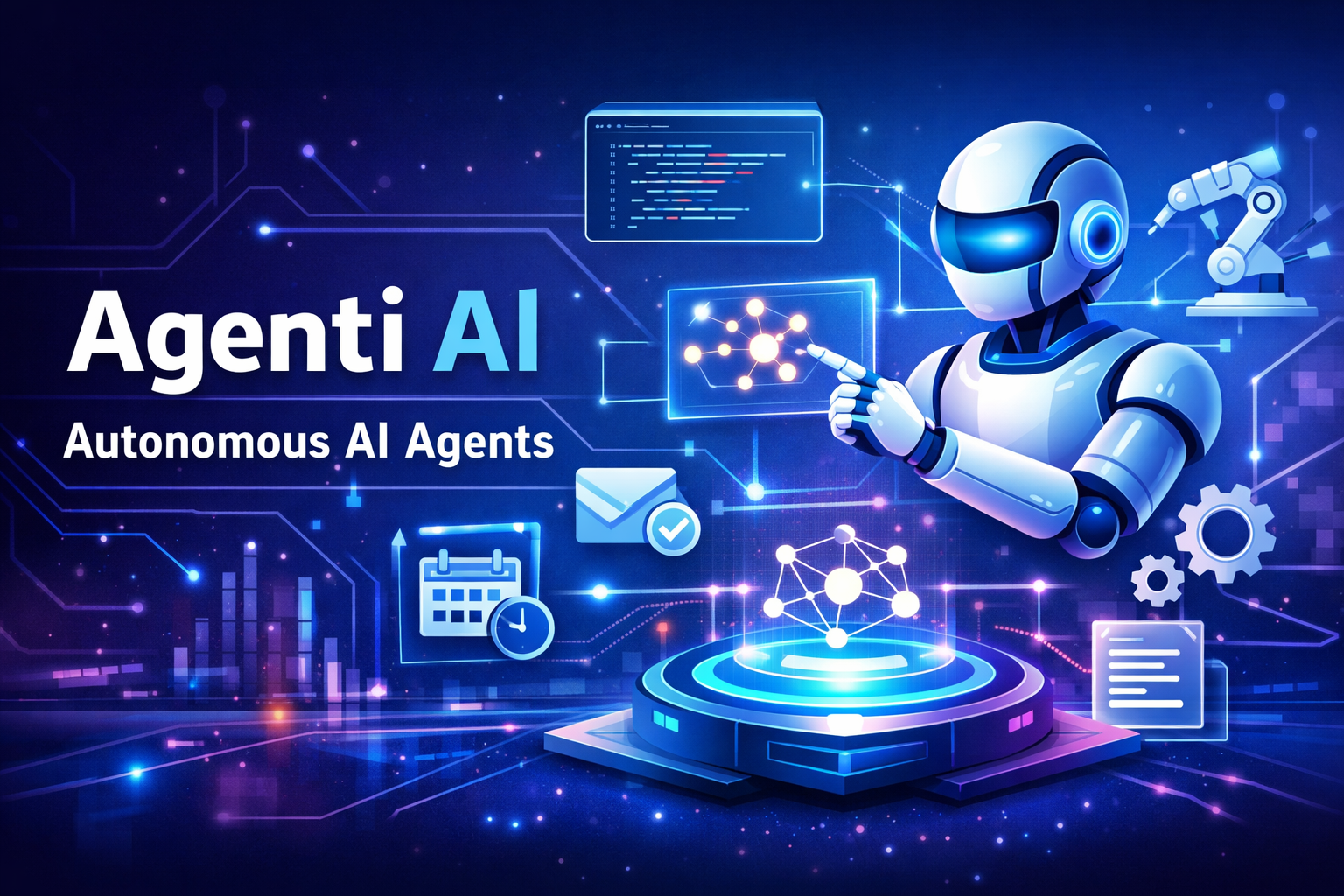
AI Agents (Agenti AI) represent a fundamental shift from prompt-based AI systems to goal-driven, autonomous, and composable intelligence. Unlike traditional AI applications that wait for user input, AI agents actively plan, reason, execute, and adapt across environments.
This article explores AI agents from a systems and engineering perspective.
What Exactly Is an AI Agent (Technically)?
From a technical standpoint, an AI Agent is a system that combines:
- A reasoning engine (LLMs / planners)
- A memory layer (short-term + long-term)
- A tool execution layer (APIs, functions, workflows)
- A control loop (decision → action → feedback)
Formally, an agent can be described as:
An autonomous system that maps observations → actions to maximize goal achievement under constraints.
Core Architecture of an AI Agent
A production-grade AI agent typically consists of the following components:
1. Perception Layer
Handles inputs from:
- User prompts
- APIs
- Databases
- Webhooks
- Sensors (IoT, logs, metrics)
Examples:
- HTTP requests
- CRM events
- System logs
- User chat messages
2. Reasoning & Planning Layer
This is the brain of the agent.
Technologies used:
- Large Language Models (GPT, Claude, Gemini, LLaMA)
- Chain-of-Thought reasoning
- ReAct (Reason + Act) pattern
- Tree-of-Thoughts
- Planning algorithms (task decomposition)
The agent breaks high-level goals into atomic tasks.
3. Memory Layer
AI agents require memory to avoid stateless behavior.
Memory types:
- Short-term memory
- Conversation context
- Current task state
- Long-term memory
- Vector databases (Pinecone, Weaviate, FAISS)
- Knowledge bases
- User preferences
Memory enables:
- Personalization
- Learning
- Multi-step reasoning
4. Tool & Action Layer
This layer allows agents to interact with the real world.
Tools include:
- REST APIs
- Databases
- CRMs
- Email systems
- Browsers
- File systems
- Code execution environments
Example:
{
  "tool": "send_email",
  "args": {
    "to": "client@email.com",
    "subject": "Follow-up",
    "body": "Meeting confirmed"
  }
}
5. Control Loop (Agent Runtime)
The control loop governs autonomy:
- Observe state
- Decide next action
- Execute tool
- Evaluate outcome
- Repeat until goal is met
This loop continues until:
- Goal completion
- Failure threshold
- Human intervention
Single-Agent vs Multi-Agent Systems
Single-Agent Systems
- One agent handles the full workflow
- Simpler but less scalable
- Suitable for small tasks
Multi-Agent Systems
- Multiple specialized agents collaborate
- Each agent has a role (planner, executor, validator)
- Communication via messages or shared memory
Example roles:
- Planner Agent
- Research Agent
- Execution Agent
- QA / Critic Agent
This mirrors human team structures.
Popular AI Agent Frameworks
Open-Source
- LangChain Agents
- LangGraph
- AutoGen (Microsoft)
- CrewAI
- Semantic Kernel
- Haystack Agents
Orchestration & Automation
- n8n
- Temporal
- Airflow
- Zapier (limited autonomy)
Memory & Vector Stores
- Pinecone
- FAISS
- Weaviate
- ChromaDB
Real-World Engineering Use Cases
AI Sales Agent
- Monitors CRM
- Qualifies leads
- Sends follow-ups
- Updates deal stages
AI DevOps Agent
- Monitors logs
- Detects anomalies
- Applies fixes
- Creates incident reports
AI Research Agent
- Browses web
- Summarizes papers
- Cross-validates sources
- Generates insights
AI Product Manager Agent
- Analyzes user feedback
- Prioritizes features
- Generates PRDs
Key Engineering Challenges
1. Hallucination Control
- Tool validation
- Output constraints
- Critic agents
2. Cost Optimization
- Token budgeting
- Caching
- Model routing
3. Safety & Alignment
- Guardrails
- Role-based permissions
- Human-in-the-loop checkpoints
4. Observability
- Agent logs
- Decision traces
- Failure recovery
AI Agents vs Traditional Microservices
| Aspect | Microservices | AI Agents |
|---|---|---|
| Logic | Deterministic | Probabilistic |
| Adaptability | Low | High |
| Learning | None | Continuous |
| Behavior | Fixed | Emergent |
| Control | Developer-defined | Goal-driven |
AI agents introduce non-deterministic behavior, which requires new engineering patterns.
The Future: Agentic Systems
The next evolution is Agentic AI Platforms, where:
- Agents discover tools dynamically
- Agents coordinate autonomously
- Agents negotiate and resolve conflicts
- Systems self-optimize over time
This leads to:
- Self-running businesses
- Autonomous SaaS
- AI-native startups
Final Take
Agenti AI is not just another AI feature.
It is a new computing paradigm.
We are moving from:
Software that executes instructions
to
Systems that pursue goals
Builders who understand agent architecture today will define the next decade of software.
If you want next
Reference architecture diagram (text-based)
Agent prompt templates (planner, executor, critic)
Production checklist for deploying AI agents
n8n + LLM agent implementation walkthrough
How to turn AI agents into a SaaS product
Say which one and I’ll go deep. drop your comment..